
People étranges
Personal highlights from this year’s Alliance Francaise French Film Festival

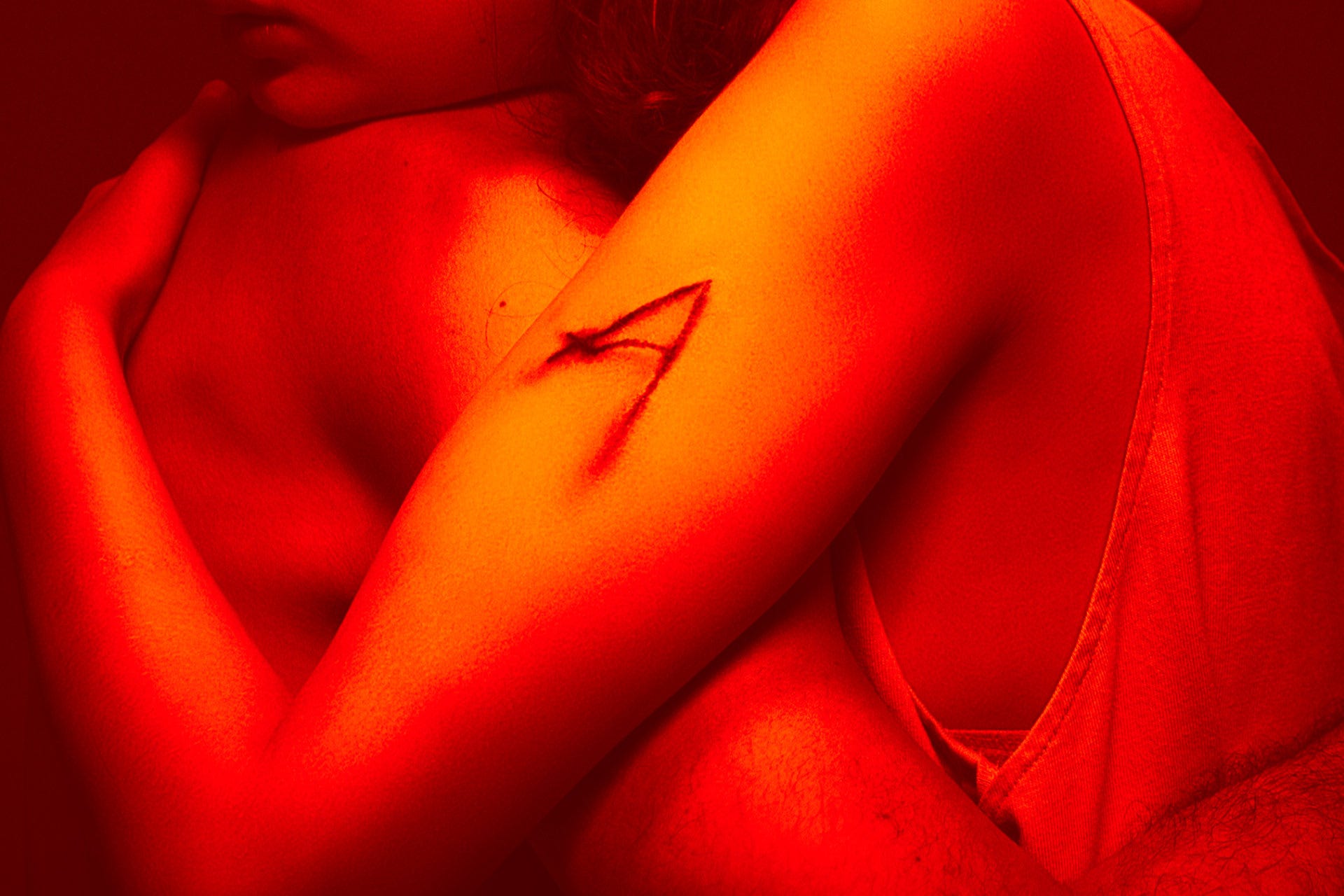
Post-annual northern hemisphere jaunt to see mum, mates and Berlinale, I don’t always have a tonne of energy left in the tank to catch French Film Festival titles on return to Melbourne. But this year I managed to catch a bunch.
Here are my faves.
Alpha
When I first saw Julia Ducournau’s debut feature, Raw (Grave), I was staggered by this fresh as spilled blood spin on the hunger of sexual awakening. Of how our insatiable cravings can make us monstrous, yes, but also powerful. Led by an astonishing Garance Marillier, it remains my favourite outing from this proudly queer filmmaker with a unique talent for rewriting old myths into something stranger still.
Thankfully, Ducournau’s career is so very far from peaking too soon. Palme d’Or-winner Titane pushed the transmogrification model into even wilder fields, as a mighty Agathe Rousselle’s motor show dancer allows herself to be kinkily impregnated by a hot rod in a film that easily shakes off simplistic comparisons to Cronenberg. Like Hermaphroditus or Iphis, our hero bends gender’s prison bars, escaping Marillier’s unfortunate lover to reach unexpectedly tender territory alongside Vincent Lindon’s wounded father figure.
So I had my suspicions when a phalanx of critics mauled Ducournau’s third feature, Alpha, out of Cannes last year, as they did (equally unfairly, in my opinion) Lynne Ramsay’s startling Die My Love. As a result, it took a loooooong time for either film to wash up on Australian shores so I could make up my own mind. I’m very glad Alpha made it.
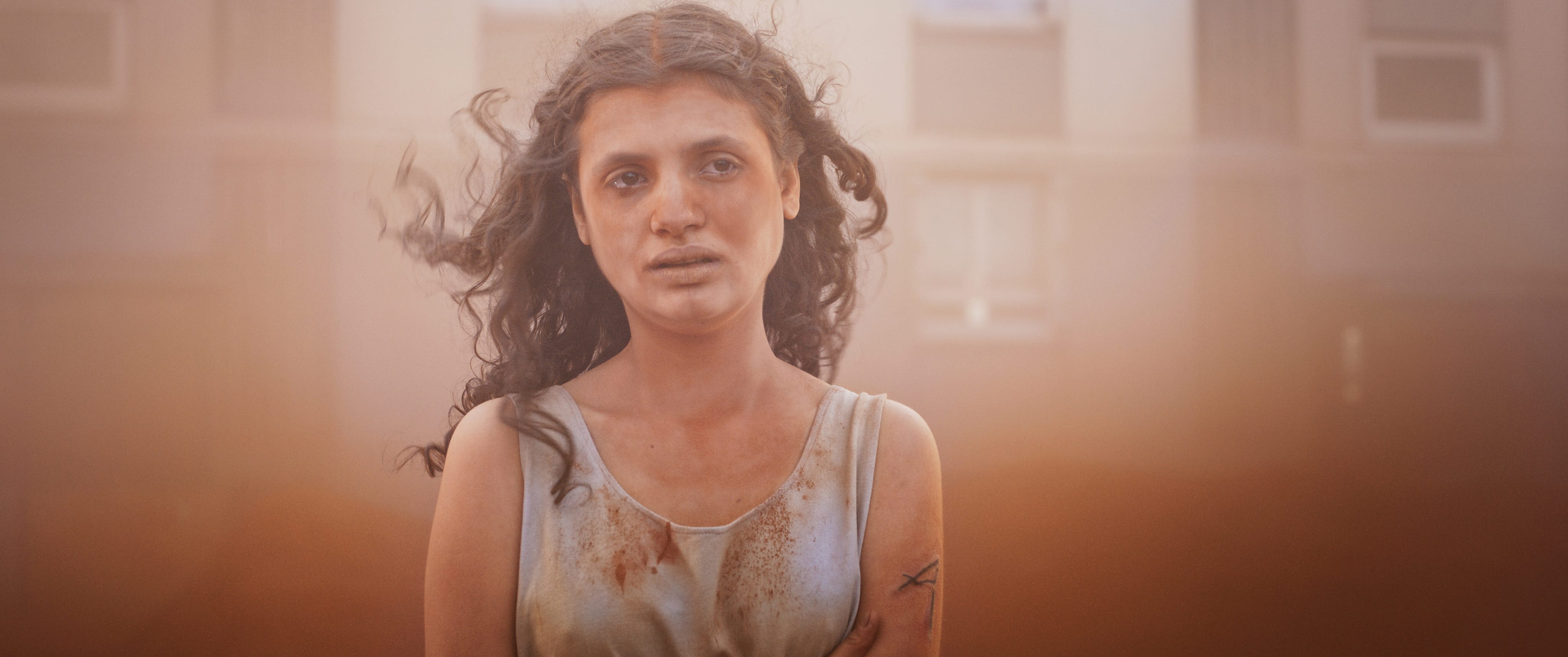
Again recasting body horror’s bones into something equally thrilling and frightening, Alpha is a suitably devastating parable of the AIDS crisis that also draws deep on Ducournau’s Amazigh heritage. Eden actor Golshifteh Farahani plays an unnamed doctor on the all-but-abandoned front lines, as many of her colleagues (but not Emma Mackey’s nurse) turn their backs on those struck down by a virus that gradually ossifies them into eerily gleaming marble, lost like petrified mortals caught between the whims of gods and monsters.
It’s a magnificently stark visual that gets at the aching heart of unimaginable loss, of those held tight in memory by friends and kind strangers when vicious families wickedly abandoned their previously loved ones. Enveloping this catastrophe in a howling red wind carrying hushed whispers – with returning cinematographer Ruben Impens and composer Jim Williams doing sterling work – Ducournau whips these small-minded judgement days into a fraught personal narrative in which fear stalks homewards.
The good doctor’s brother, the brilliant Tahar Rahim’s Amin, is caught in the curse’s cold-handed grip. Then her daughter, the titular Alpha (excellent emerging actor Mélissa Boros), gets tattooed at a party with a passed-around needle also used by her secret boyfriend (Louai El Amrousy).
As maternal and sororal anguish refuse to give way to despair, a battle is unleashed for the future that’s bound up in the past in this non-linear marvel of simultaneously epic and intimate proportions. Alpha’s final images will stay with me forever, with Ducournau’s unruly magic undimmed, whatever some folks might say.
The Stranger (L’étranger)
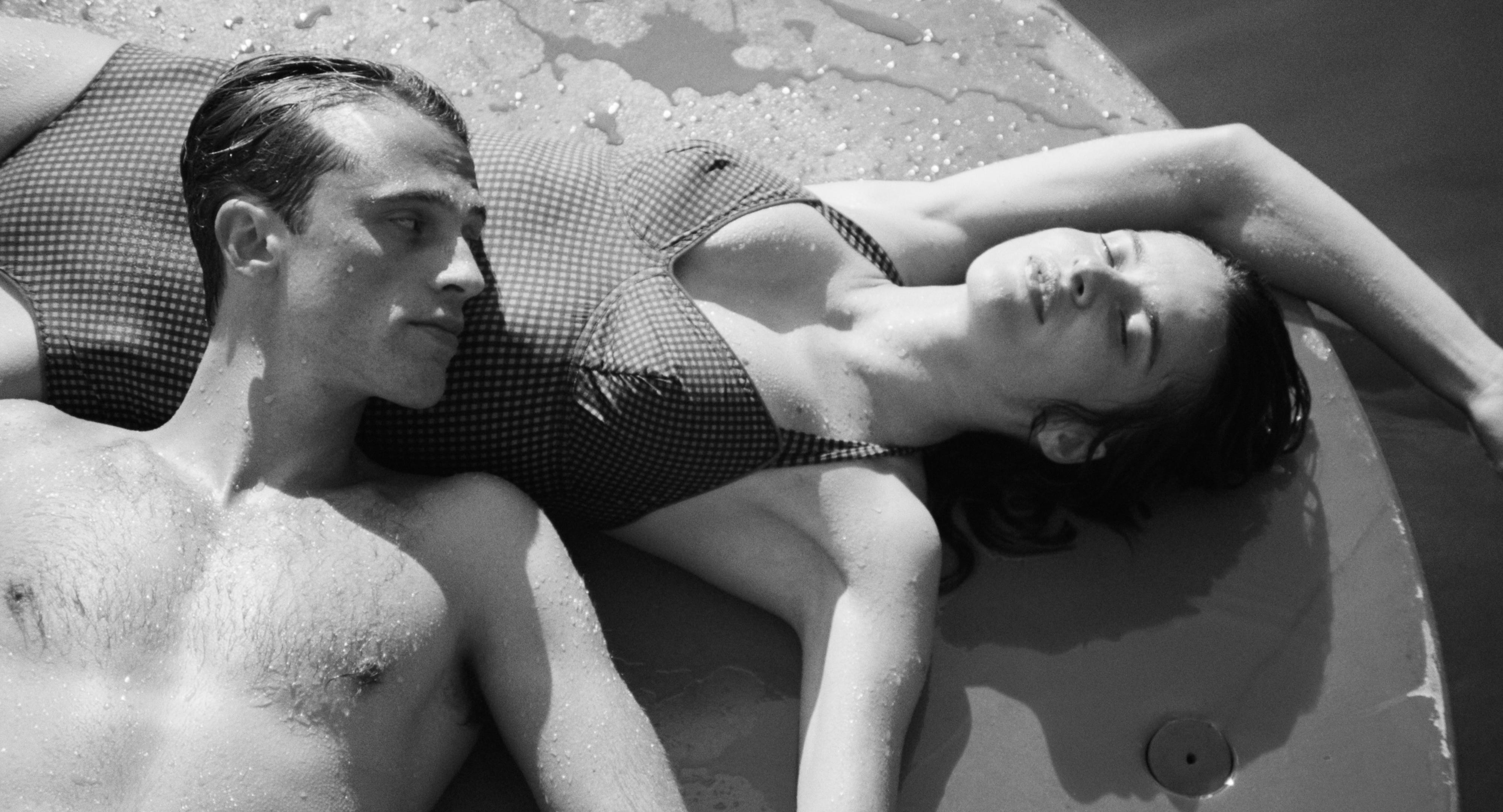
The inimitable François Ozon, like Ducournau, is a fabulously unpindownable French filmmaker whose shapeshifting career is effervescently queer, even when the films aren’t explicitly so. As is the case with his lusciously black-and-white, but far from binary, read on Algerian-French existential author Albert Camus’ beguiling The Stranger (L’étranger).
As dazzling as cinematographer Manuel Dacosse’s kaleidoscopic work on Reflection in a Dead Diamond, Ozon’s sun-kissed reverie reengages his mercurial Summer of 85 (Été 85) star, Benjamin Voisin, as the unbothered, angular in shape and spirit shipping clerk, Meursault. He scandalises the staff and the residents of his late mother’s nursing home with his casual disregard for custom and inability to loosen even one tear.
A cog in the colonial machine, Meursault is equally uninterested in his job as he is in taking on, then easily discarding, Rebecca Marder’s lover, Marie, with the dust barely settled on his mother’s grave. Nor is he overly troubled by the violence of his sleazy neighbour, Raymond (Ozon’s ace When Fall Is Coming lead, Pierre Lottin), a racist cad who beats his Arabic lover, pointedly unnamed in the novella, but here known as Djemila (Hajar Bouzaouit). But it’s the murder of her brother, also granted a name here, Moussa (Abderrahmane Dehkani), that ignites the court case that will brings Meursault closest to, but not quite touching, feeling.
Ozon knows exactly how to unravel the absurdity of this handsomely ambiguous sociopath, one whose big splash ripples ever outwards towards Patricia Highsmith’s Ripley. There’s a tantalising suggestion that Camus’ deliberately provocative antihero may be intent on destroying an inherent queerness within him.
However you read Ozon’s equally warped reflection of the Camus, The Stranger is a crystalline distillation of our casually cruel times, one that will linger in the creeping corners of your mind long after you leave the cinema, thanks in no small part to Voisin’s ravishing turn as our dapper, if dangerously unknowable, drifter. Set to a shimmeringly unsettled score by Senegal-Kuwaiti composer Fatima Al Qadiri, who worked on Dahomey director Mati Diop’s haunted Atlantique, it’s a tantalisingly opaque Rorschach.
Out of Love (Les enfants vont bien)
Abundantly gifted, the ever-watchable force that is Cammile Cottin shot into the popular consciousness with her non-nonsense turn as errant French film star-wrangler Andréa Martel in Call My Agent! (Dix pour cent), further solidifying her global appeal with a villainous turn as the assassin queen, Helene, in Killing Eve.
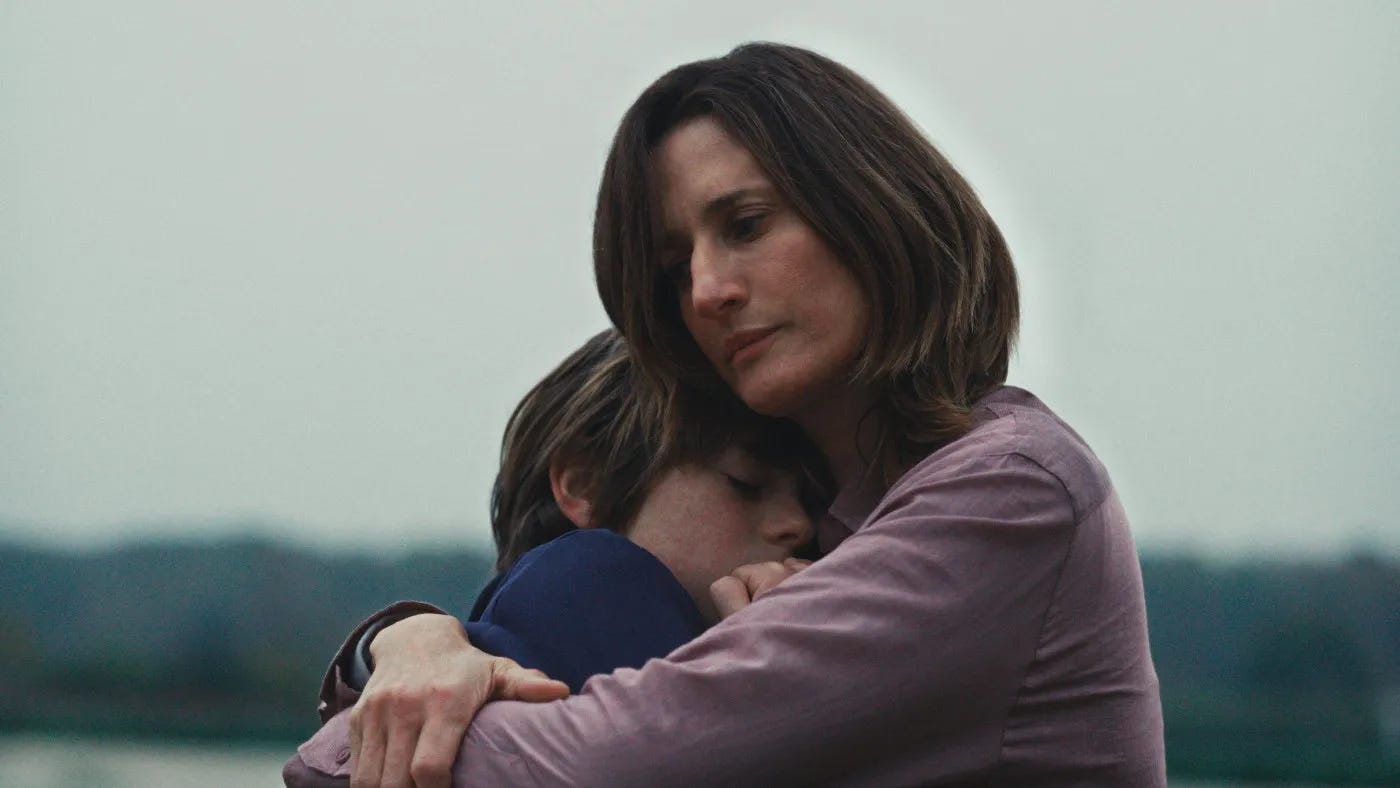
Cottin is deployed subtly in writer/director Nathan Ambrosioni’s delicately judged Out of Love (Les Enfants vont Bien). As Jeanne, who works in insurance, she’s all business, having broken off her marriage to Nicole (a delightful Monia Chokri), an artist, over the latter’s desire to have kids.
It’s in the good-natured wake of this break that Jeanne’s absent-mindedly estranged sister, Suzanne (Juliette Armanet), shows up out of the blue with her children, Gaspard (Manoa Varvat) and his younger sister Margaux (Nina Birman). Just as Jeanne and Suzanne appear to be regaining emotional ground despite a deep fracture, Suzanne disappears without a trace, leaving only a letter and far too much playful noise in her gobsmacked sister’s architecturally pristine country home.
What follows, as Jeanne’s exceedingly reluctant mother figure struggles to balance her workaholic nature with their unasked-for care, the kids just as reluctant to surrender themselves, is bogged down in a mess of paperwork and societal expectations. That the kids weren’t abandoned, but left in Jeanne’s care, according to French law, leaves them treading hopelessly complex legal waters. In a twist of irony, Nicole helps carry the load.
Cinematographer Victor Seguin adeptly frames the unspoken beats hovering between the tight ensemble. Chokri and Armanet both bring presence to their support roles, with the young actors layering remarkable depth of feeling into their too soon careworn faces. There are no easy answers in Ambrosioni’s gently unmooring film that stands tall on Cottin’s always impressive shoulders.
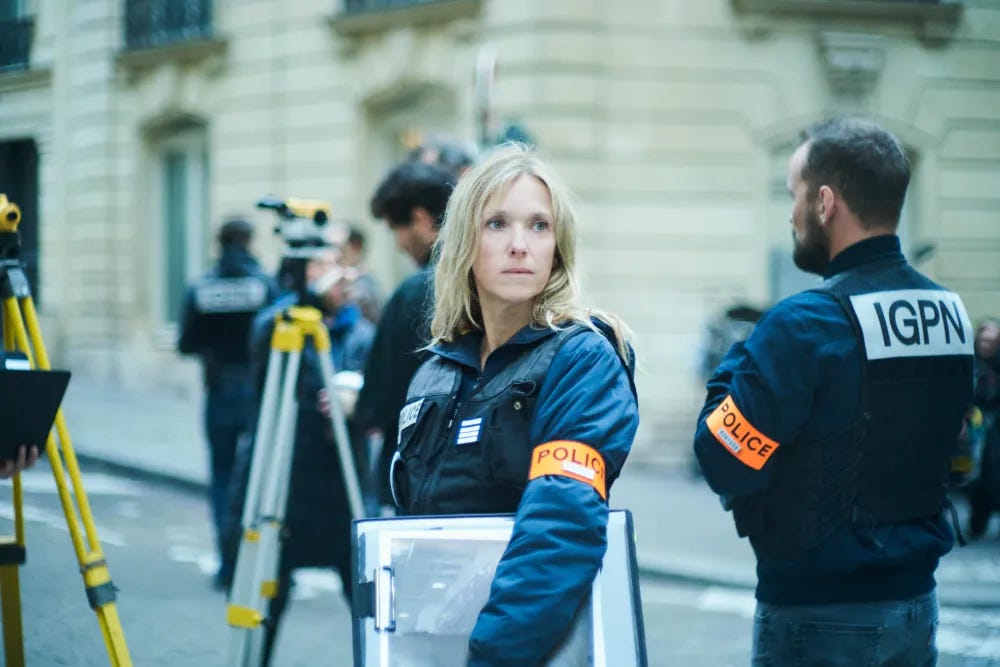
Case 137 (Dossier 137)
Speaking of French actors I can’t get enough of, the prolific Léa Drucker is one of my low-key faves. If you haven’t seen her César-winning turn in Custody (Jusqu’à la garde), rush to do so. Also check out her anchoring of Lukas Dhont’s subtle knife of a film, Close, her memorable appearance in Marina de Van brutal body horror, In My Skin, and Howard Overman’s TV adaptation of War of the Worlds.
Director Dominik Moll (The Night of the 12th/La nuit du 12) keenly understands Drucker’s gift for quiet acting, where more is said in the way she holds her fame or the flicker of a facial muscle than the lines given to her by him and his co-writer, Gilles Marchand, in Case 137 (a silly and redundant anglicisation of Dossier 137).
As Stéphanie, she is a police investigator of the internal kind, tasked with examining the purposefully muddied facts surrounding a wave of police brutality conducted by her colleagues during the ‘Gilets Jaunes’ or Yellow Vests protests. The movement was led by predominantly working-class folks nationwide, centred on Paris, in resistance to a belligerent President Emmanuel Macron’s inequitable policies.
We can infer that Stéphanie leaving the beat for a desk in this department played a part in her separation from needling husband, Jérémy (Stanislas Merhar), whose equally confrontational new flame is with the union. We hear, second-hand, that their son, Victor (sweetly played by Solàn Machado Graner), tells schoolmates his dad’s a teacher. Jérémy can’t quite grasp that this has more to do with anti-cop public sentiment than his ex-wife’s switch to policing the police.
Closely pursued by cinematographer Patrick Ghiringhelli’s viscerally bobbing camera, we tag along as Stéphanie investigates events leading up to the non-fatal, but life-changing, shooting in the head of a young first-time protester, Guillame (Côme Péronnet), who came to Paris with his family and best friend.
Avoiding overt dramatics, Case 137 gains its power from following Stéphanie’s methodical placing of impossible pieces that lead her to so-called heroes and into hot water with the powers that be. It’s bracing without being bombastic, with a brilliant turn for Saint Omer and The Beast star Guslagie Malanda as a hotel cleaner reluctantly drawn into the web of lies who wonders aloud, pertinently, if the same effort would have been put into the case if the victim weren’t white? Powerful stuff.
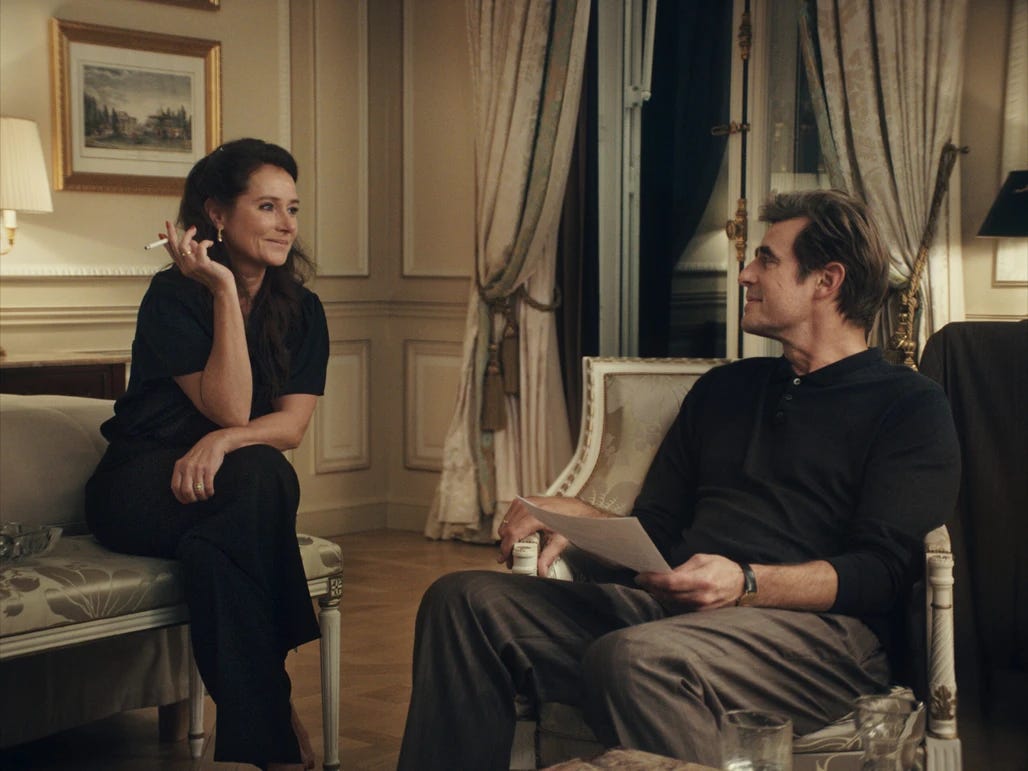
The Great Arch (L’inconnu de la Grande Arche)
While the local French Film Festival does tend to focus a little too tightly on the mother country and not enough on diaspora stories, it’s a treat to see three great actors from further afield shine in director Stéphane Demoustier’s The Great Arch (L’inconnu de la Grande Arche).
Adapted from the novel by Laurence Cossé, it features Claes Bang, star of The Square, The Northman and William Tell, as surly real-life Danish architect Johan Otto von Spreckelsen. Despite being a largely unknown quantity, his design was hand-picked by then-President François Mitterrand (Ozon’s Swimming Pool actor, Michel Fau) for the planned Grande Arche de la Défense, to be erected in time for the bicentennial of the French Revolution.
Also fluent in English, German, Swedish and Norwegian, the polyglot Bang doesn’t actually speak French, learning his lines phonetically, but you wouldn’t know it from his commanding presence here. Otto comes to Paris with his partner in life and business, sculptor Liv (real name Karen Gerda Gustavsen), played by legit French speaker Sidse Babet Knudsen of Borgen, Limbo and The Duke of Burgundy fame. They’re joined by French-Canadian director and gigging actor Xavier Dolan, as composite character Jean-Louis Subilon, standing in for every penny-pinching bureaucrat with an unbending commitment to stuffy order.
If you’re at all familiar with the curse of the Sydney Opera House, you’ll know that these grand projects of great import are often mired in a battlefield of clashing egos, political interference and Subilon-style scurrying. As such, the floatily cerebral vibes of Otto and Liv clash immediately with the details-driven pernicketiness of Anatomy of a Fall star Swann Arlaud’s frustrated Charles de Gaulle architect, Paul Andreu. He’s nevertheless willing to take a backstep, adopting the title of project manager, because he truly believes in the beauty of this design for the ages, a titanic reimagining of the Arc de Triomphe that sits in perfect harmony within its sightline.
Mitterrand, himself a divisive figure, also sees it as his foothold on eternity, but political forces on the right will soon punt his presidency into the footnotes as the project undergoes a near-death of a thousand cuts, which Demoustier suggest crushes Otto, body and spirit. Which may be true, to an extent, though cancer also played its part. Some of the facts are played pretty loose here, and fair enough.
No matter. Held in the 4:3 ratio by cinematographer David Chambille, with its echo of the cube itself, The Great Arch is pleasingly colour graded with a grainy effect that’s passably closer to film that the usual digital sheen and the production also used contemporaneous slides of the construction process blown up in high definition alongside subtle CGI to hurl us back in time, alongside temporarily shutting the Champs-Élysée and flooding it with period-appropriate cars. It’s a gorgeous film with a melancholic heart that speaks to the assault on art by those empty souls who will always see human excellence as worthless.
Elsewhere
A chat with Cate Blanchett and Jim Jarmusch about Father Mother Sister Brother
An Interview with The President’s Cake director Hasan Hadi
Thoughts on The Drama and dark anxiety comedy, and rip-roaring documentary 1000 Women in Horror
My review of I Swear.
I liked Raw but I *loved* Titane (I did come to them in the opposite order, though don't know that really tilted my enjoyment at all), so really glad to read that Alpha is also well worthwhile!
Will be putting almost everything else here on my hopeful-watchlist as well.
I’m keen to see Alpha. Must catch up with Titane too. Loved Raw of course!