
Speak up
On the devastating clarity of Kaouther Ben Hania’s The Voice of Hind Rajab

“The Ministry of Peace concerns itself with war, the Ministry of Truth with lies, the Ministry of Love with torture and the Ministry of Plenty with starvation.
“These contradictions are not accidental, nor do they result from ordinary hypocrisy: they are deliberate exercises in doublethink.”
Just as prophetic satirist George Orwell predicted, in his novel 1984, quoted above, and elsewhere, we live in deliberately warped times that have been bent right out of shape by resurgent fascists and their boot-licking lapdogs everywhere.
By the war criminals who will say they never bombed a hospital or school, victim-blaming instead. Then, when caught in that bare-faced lie, lie again, pretending that these life-giving and soul-enriching spaces weren’t at all what they were before they were razed. As with most of Gaza, at Israel’s command. A rogue terrorist state founded on anhorrent apartheid lines that’s now assaulting Iran, Lebanon and more, supported in these atrocities by doublethinkers from the US to the UK and Australia.
But bend and break the truth as these murderous brutes may, it exists. Voices silenced by snipers cannot be entirely erased, or the dead disappeared. They linger on in our memories. And sometimes on tape.
Green Light
So it is with five-year-old Palestinian girl, Hind Rajab. Nicknamed Hanood, she was in the backseat of her aunt and uncle’s car, alongside her cousins, when the family was forced to flee the Israeli army’s merciless shelling of their now-flattened neighbourhood, Tel al-Hawa. A war crime denied – the tanks were never there.
But they were, as exposed by journalists. Rajab’s 15-year-old cousin, Layan Hamadeh, managed to call the Palestine Red Crescent Society before she, too, was slaughtered, leaving Rajab alone on the phone for hours as the organisation scrambled to send an ambulance into the warzone.
A call-out that must be given the green light by either the Red Cross or the Ministry of Health, some 50km away in the West Bank, independently coordinating with the IDF, who were informed of the wounded Rajab’s whereabouts and of the heroic, yet doomed, ambulance drivers eventually sent to save her, Youssef Zaino and Ahmed Al-Madhoun, yet slaughtered them all the same. Like so many first repsonders, yet more war crimes.
Debuting at the Venice Film Festival, The Voice of Hind Rajab, Tunisian filmmaker Kaouther Ben Hania’s gut-wrenching, form-melding film, ensures that the five-year-old Rajab’s voice will never, ever be silenced by her monstrous murderers. No matter how hard they tried, strafing her family’s car with 355 bullets and obliterating the ambulance, their repugnant crime is now prosecuted by Ben Hania’s Oscar and Golden Globe-nominated defiant triumph, which won the Grand Jury Prize Silver Lion.
It’s a remarkable feat that honours, at its centre, Rajab herself.
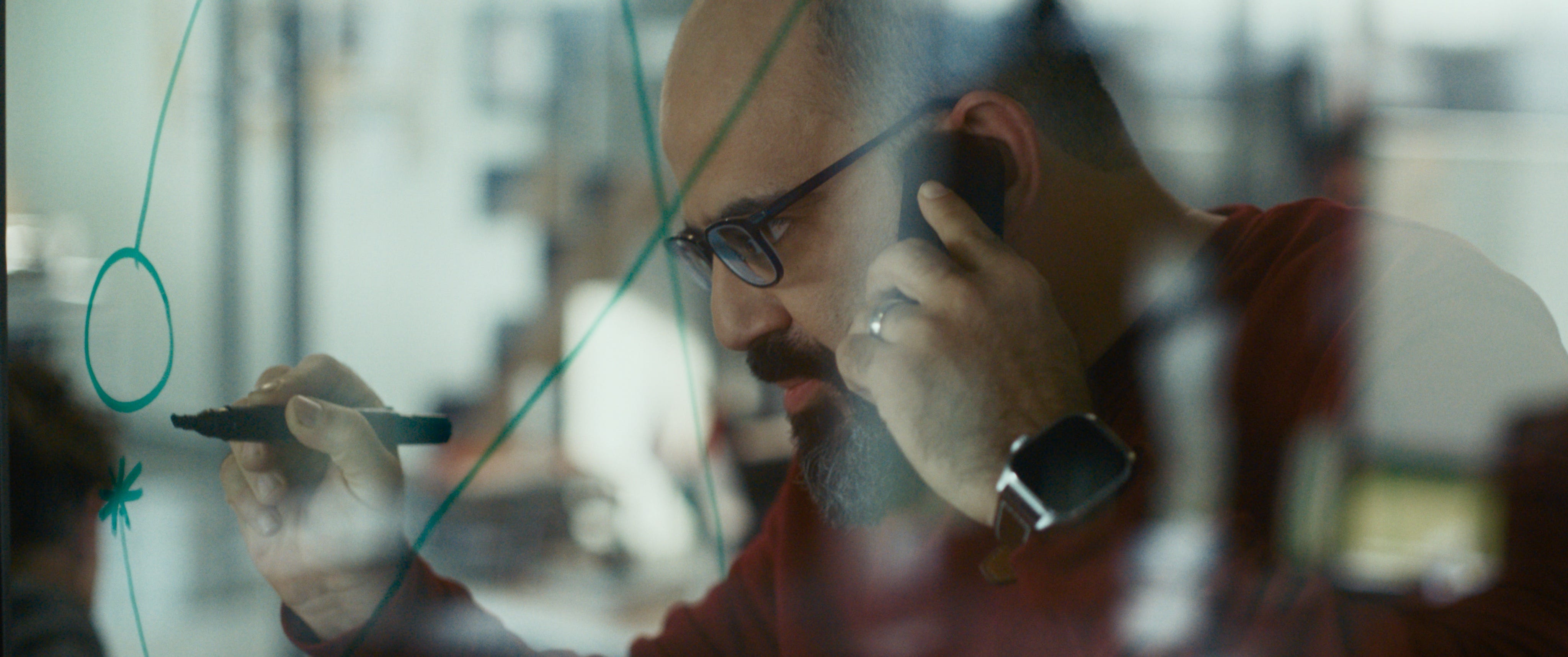
Much like Swedish director Gustav Möller’s surprisingly propulsive thriller, The Guilty, the devastating drama of The Voice of Hind Rajab plays out entirely within the confines of a call centre. The staff are depicted by actors, including Palestinians Motaz Malhees, who recently cropped up in the remake of Speak No Evil, as Omar and Chronicles from the Siege’s Saja Kilani as Rana. Mediterranean Fever star Amer Hlehel plays their cautious boss, Mahdi, with Baghdad Central’s Clara Khoury as their counsellor, Nisreen.
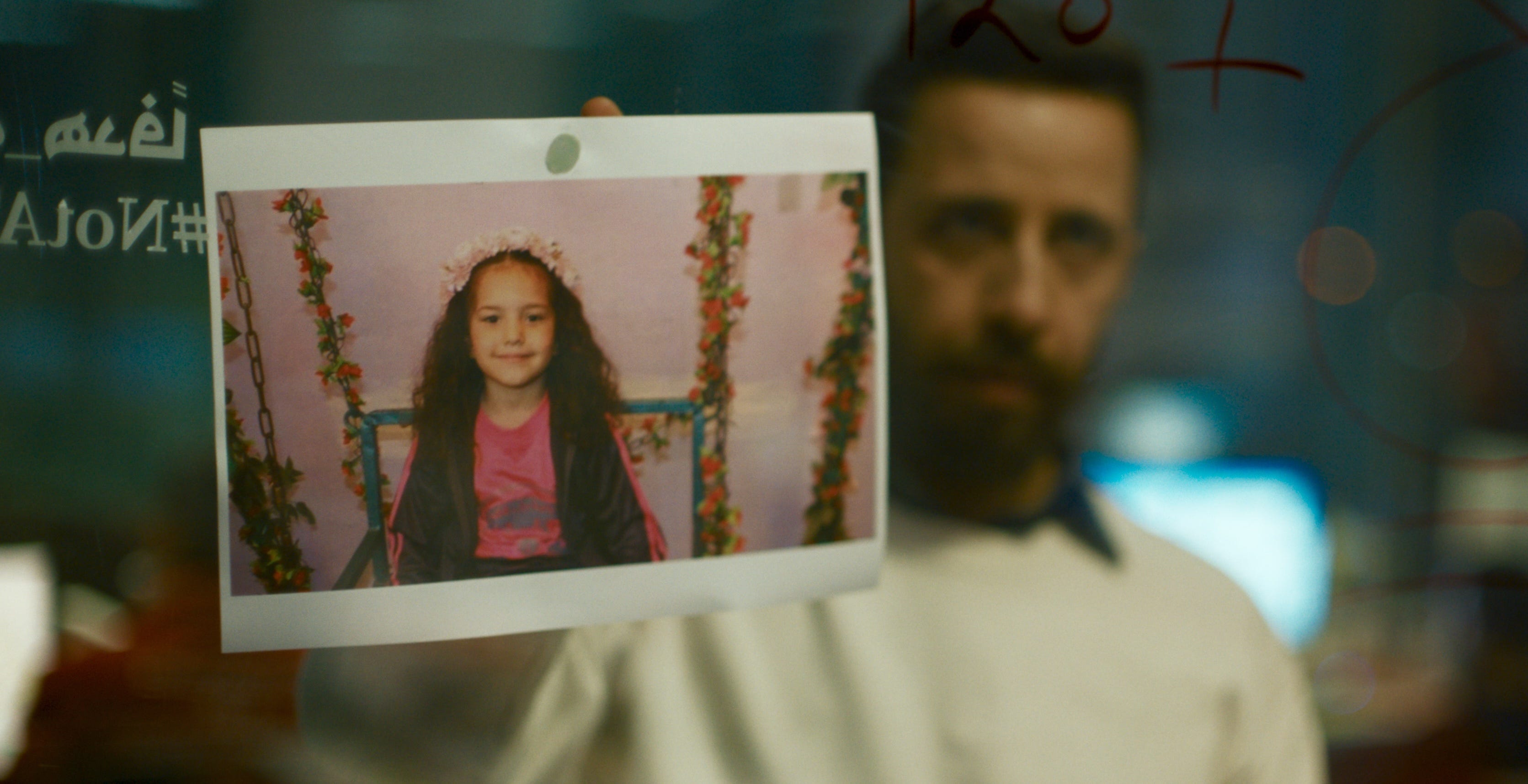
But this is no strict fiction. Ben Hania’s screenplay is drawn from meticulous interviews with the real-life staff who valiantly battled in vain to save Rajab. The directors cast respond to the actual recordings of Rajab’s desperate final hours, alone and terribly afraid as soldiers continued to shoot at her, surrounded as she was by the violated bodies of her nearest and dearest.
Some folks have raised qualms around the morality of using Rajab’s real voice. Personally, while I can see their concerns, I do not share them. It’s why a growing number of us refuse to turn away from the truth we see plainly before our very eyes and hear with our own ears. Rajab’s testimony is integral to this refusal to allow her voice to be annihilated. This reconstruction is a refusal to allow her murderers to rewrite her story with their lies.
Silence is violence
Thanks to a startling performance by Malhees, we feel Omar’s unbearable exasperation, rising inexorably to unbridled fury, as he wrestles with the inflexible machinery of due process, battling to dispatch an ambulance that is a tantalising eight-minute drive away from Rajab’s under-fire location.
And yet, we can understand Mahdi’s reluctance to send ambulance drivers into a firestorm, even if he had the power to do so, rather than navigate complicated official channels. He’s visibly haunted by the faces of fallen comrades stuck to the glass walls of his suffocating office. Omar can only see excuses, as they almost come to blows. “She doesn’t have time.”
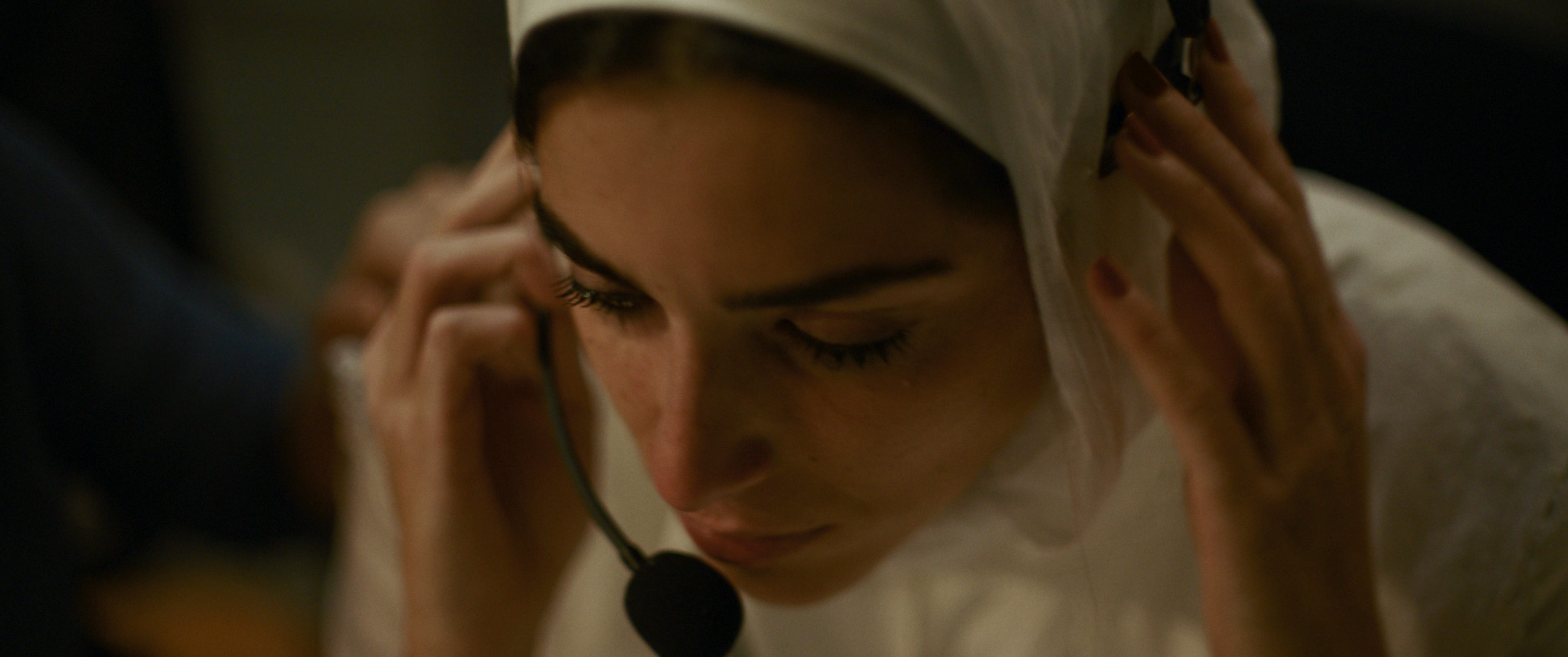
Caught between them, Kilani’s Rana is a constant, a kind and calm voice that Rajab can cling onto, though the immense emotional pressure this piles on the call centre manager is excruciating to witness, commendably communicated by the top-notch cast.
So profound is her spiralling despair that Khoury’s Nisreen attempts to step in on several occasions, but the terrified young girl on the other end of the line only has so much trust to spare. When Nisreeen resorts to mindfulness techniques, including breathing exercises and asking Rajab to imagine smelling a flower, this no-doubt valid approach nevertheless vexes. Confusion reigns as Rajab, but a girl, struggles to understand some of their questions and the call centre staff battle to hear her responses clearly enough.
All the while, the line drops out repeatedly, whether through the catastrophic collapse of Gazan infrastructure or the deliberate jamming machinations of the IDF. As magnificent as the actors are, we long to hear the real voice of Rajab once more, willing reality to bend for the good, rather than the malignant manipulations of doublethinkers, so that she can be saved – this despite us all knowing the awful truth.
Ben Hania holds us in this impossible moment, as several hours folds into an excruciating 90 minutes you will not easily forget. Because we must not. Rajab and the many thousands of innocent civilians like her, slaughtered by the brutish forces of great evil, demand our ears. Our memories. Our voices.
Silence is complicity.
Elsewhere
Over at ScreenHub, I review The Testament of Ann Lee, Sirât and The Bride!
I interview Ann Lee star Amanda Seyfried for the ABC.
For Time Out, I reviewed The Moment and Good Luck, Have Fun, Don’t Die
And here are my top picks from this year’s Berlinale
Excellent post. Silence is violence and complicity, but also cowardice, the absolute refusal to risk one iota of comfort or security by pointing out the monstrous crime that is unfolding. Besides the slaughter in Gaza itself, which makes all of our feelings about it seem trivial, the hardest realization I've experienced these last two years is that we are surrounded by a majority of cowards.